Utah State Parks

Utah State Parks
Hiking Wild Horse Canyon

Wednesday, March 26, 2014

Italy, Day 7 - San Gimignano

This day, our trip to San Gimignano,  proved to be my favorite!  Once again we rode a bus and passed a cemetery filled with graves of American soldiers who died in Italy during World War II.
Picture taken from the bus

Rick Steves video about San Gimignano

I love the little niche dedicated to the Blessed Virgin
The famous well and famous guests, Paula and Theresa


Paula and I walked this trail to get a better view of the Medieval Village

We spent a lot of time shopping.  Claudia recommended this leather shop and sure enough Paula and I bought a genuine "Made in Italy" leather handbag!


We enjoyed our visit with this woman who just opened her ceramic shop three days ago.  She and her husband make and paint all the pottery.  Some of it came home with us to the U.S.


This sweet woman waited on us at Bar LeTori....we took cookies with us for the long ride home.

After lunch, we had the privilege of visiting Fattoria Poggio Alloro, a family working farm.  We met Sarah Fiorini, a third generation family member.  She's passionate about her family, this land, and all the products that come from it.  
She spoke about her grandfather and his brothers who bought the land and barely survived during the depression and subsequent years.  "People often ask me about the three brother's intention when they bought the land.....it never occurred to them the farm might be a source of revenue, they just wanted to provide a way to feed their families with healthy, home grown food."

Sarah delighted us with her stories about the family and we learned that she's published a cookbook and now comes to America and teaches cooking classes.  I ordered the cookbook, not only for the recipes, but also to read the stories about the family farm.  

The farm has a large organic vegetable garden, olives, grapes, and the sweetest white cows.


Toni, right at home, among the wine barrels!

The farmers make wine, olive oil, and cheese.  The family set out the most incredible wine tasting event!  We enjoyed five tastes of wine, with bread, salami, cheese and the grand finale, biscotti with sweet wine!


We all wanted to purchase the wine and olive oil!

I bought some biscotti to share with friends at home....will have to find a great sweet wine and serve it in the evening.  I've only eaten biscotti for breakfast, but now it's my favorite dessert!


If I ever make it back to Italy I hope to stay at the Bed and Breakfast on this farm.  It's so peaceful here, quite a contrast to the cities we've visited.  The family's desire to serve only healthy, organic food impressed me.  And, look at the view of San Gimignano from the wine tasting room!


 Two Camas Prairie, St. Gertrude's Academy Alums enjoying Tuscany!  Marilyn and I both have family ties to Greencreek, Illinois....

Tuesday, March 25, 2014

Italy, Day 6 - Cinque Terre

We left early for Cinque Terre,  amidst rain and clouds everywhere.  We drove the same route as we had to get to Lucca.  We passed a small town, Collodi, and Claudia told us the author of Pinocchio spent summers there.   We noticed Pinocchio shops everywhere we travelled.  He's very popular in Italy with the tourists and souvenir shops.

We also passed several "bread factories."  We ate lots of Italian breads including ciabatta and foccacia.  Waiters served bread with every meal, along with olive oil and balsamic vinegar.    Pizza, also considered a bread,  got it's humble beginnings as street food in Napoli and Queen Margherita is partly responsible for spreading the pizza craze to all corners of the globe.  We learned from Claudia that Italian bread has no salt because years ago there was a tax on salt and the bakers were stubborn and refused to pay the tax so they left salt out of the bread.  They reasoned that salami and pesto has enough salt to flavor even the bread, when eaten together.

 Pictures of the Apuan Alps taken while parked at a rest stop.  These Alps are famous for white marble.


The bus driver dropped us off at La Spezia and we rode the train to three of the five villages in Cinque Terre.  
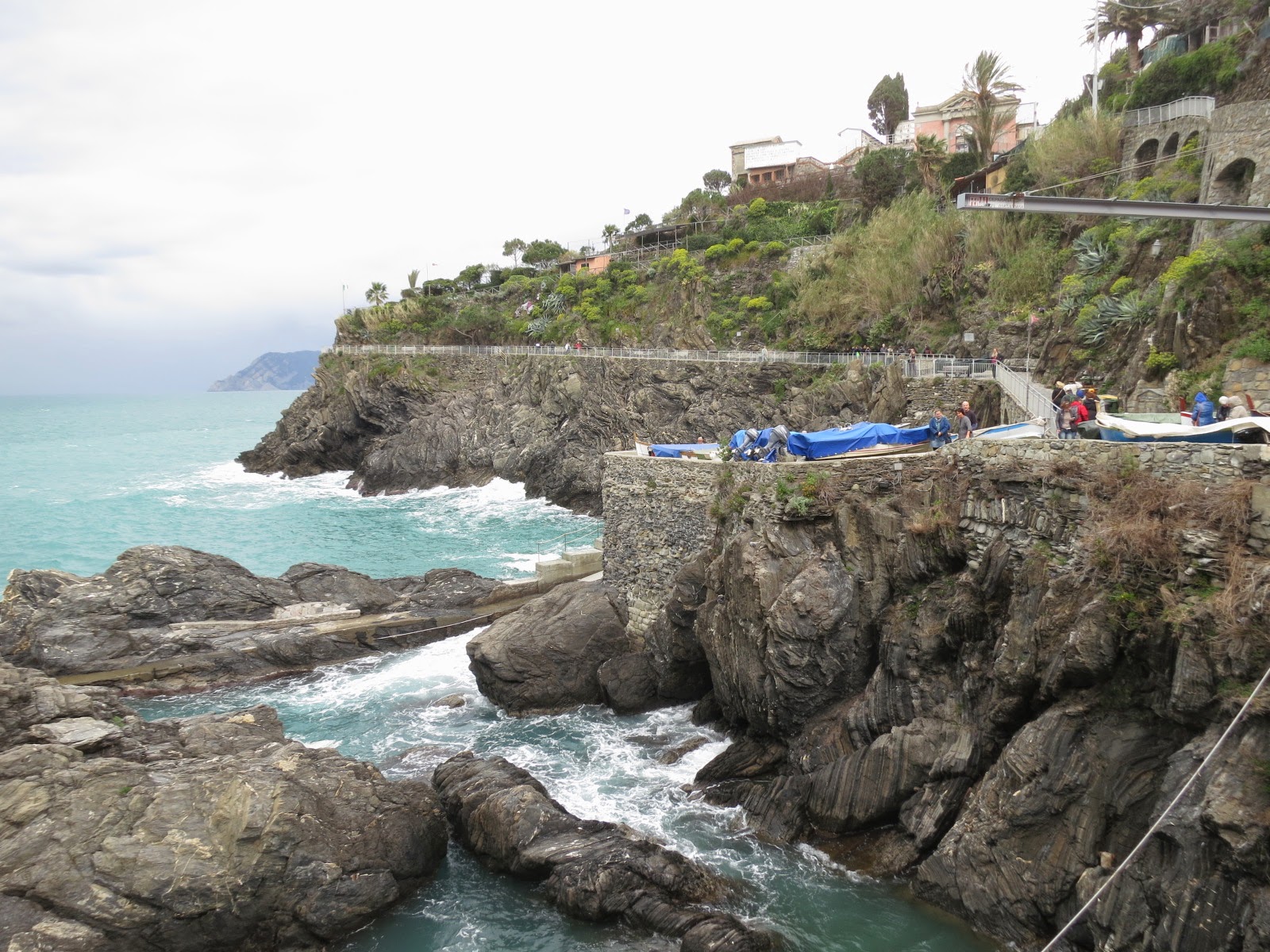
Photo shoot in Manarola
Fishermen painted their houses in bright colors so they were easily visible from the sea.  

It's typical to see laundry drying outside all over Tuscany.  
From Wikipedia:  The first historical documents on the Cinque Terre date back to the 11th century. Monterosso and Vernazza sprang up first, whilst the other villages grew later, under military and political supremacy of Genoa. In the 16th century to oppose the attacks by the Turks, the inhabitants reinforced the old forts and built new defence towers. From the year 600, the Cinque Terre experienced a decline which reversed only in the 14th century, thanks to the construction of the Military Arsenal of La Spezia and to the building of the railway line between Genoa and La Spezia. The railway allowed the inhabitants to escape their isolation, but also brought about abandonment of traditional activities. The consequence was an increase in poverty which pushed many to emigrate abroad, at least up to the 1970s, when the development of tourism brought back wealth.
The variation of house colors is due to the fact that while fishermen were doing their jobs just offshore, they wanted to be able to see their house easily. This way, they could make sure their wives were still home doing the house work. Most of the families in the five villages made money by catching the fish and selling them in the small port villages. Fish was also their main source of food.
The Cinque Terre  is a rugged portion of coast on theItalian Riviera. It is in the Liguria region of Italy, to the west of the city of La Spezia. "The Five Lands" comprises five villages: Monterosso al MareVernazzaCornigliaManarola, and Riomaggio.  
Over the centuries, people have carefully built terraces on the rugged, steep landscape right up to the cliffs that overlook the sea. Part of its charm is the lack of visible corporate development. Paths, trains and boats connect the villages, and cars cannot reach them from the outside. The Cinque Terre area is a very popular tourist destination.


Manorola

Monterosso
We walked through a tunnel, to the old section of Monterosso for lunch.


 The waiter charmed us with his wit and patience when we asked a lot of questions.
Toni watched, with anticipation, as he deboned the whole fish she'd ordered


Paula and I shared an order of grilled Scampi and Trofie Pasta with Pesto Sauce.  


The lighting and table settings impressed us as well as the scrumptious food and wine.


We had a little time before our train left so we walked up the street and Paula befriended this sweet boy who painted rocks.  She paid him for a shark-shaped rock.  We stopped long enough for a pictures among the marguerite daises.


Our next stop, Vernazza

Paula and I walked to the Church.  It was raining so spending quiet time was a nice respite for us.  I don't know the name of the church, but it was decorated by and for fishermen.  


View of Vernazza from the Church

Claudia pointed out the Carrara Marble quarries on the trip back to Montecatini.  There are 770 quarries in the city.  Sculptors use this marble mostly for statutes.  We noticed lots of cranes and huge pieces of marble ready for shipment.

Claudia also gave us a little geography lesson about the Liguria area, where Cinque Terre is located.  Parts of this area are also called the Italian Riviera, along the Mediterranean Sea.  She said many Italian families have summer homes in this area.  When she mentioned the province bordered France I thought about Bradleigh, my granddaughter, who will be flying to Paris on Friday.  I think Nice is just across the sea from Cinque Terre.  
A=Nice in France; B=La Spezia


Monday, March 24, 2014

Italy - Day 5, Siena

Monday, our 5th Day in Italy, we rode the bus to Siena.  It was a sad day in a way because Mona and Carole did not join us.  Mona discovered this morning that her wallet was missing and she needed to stay back and cancel her credit cards, etc.  Shirley and others were exhausted from the strenuous walking yesterday so they also took a break and rested at the hotel.


We first traveled to the Church that houses the head and a thumb of St. Catherine of Siena, situated in the Plaza of Mother Teresa.  
We were unable to take any pictures inside the church.  The guide told us 
this is the church where St. Catherine of Siena prayed and attended Mass.  Only her head and one thumb are preserved here, other parts of her body are in Rome.  She apparently walked from Siena to France and told the Pope to get back to Rome.... and he did.  I lit candles for all my friends suffering from cancer and other health issues, especially remembering my former husband who faced surgery in Seattle today.  

Anna Lisa gave us a great tour of this medieval city.  We climbed lots of hills in this city. She explained along the way how people were born in sections of the city and remained loyal to their family and districts.    Wikipedia:  contrada is a district, or a ward, within an Italian city. The most well-known contrade are probably the 17 contrade of Siena that race in the Palio di Siena. Each is named after an animal or symbol and each with its own long history and complicated set of heraldic and semi-mythological associations.ese districts were set up in the Middle Ages in order to supply troops to the many military companies that were hired to defend Siena as it fought to defend its independence fromFlorence and other nearby city states. As time has gone by, however, the contrade have lost their administrative and military functions and have instead become simply areas of localised patriotism, held together by the emotions and sense of civic pride of the residents. Their roles have broadened so that every important event – baptisms, deaths, marriages, church holidays, victories at the Palio, even wine or food festivals – is celebrated only within one's own contrada.  Every contrada has its own museum, fountain and baptismal font, motto, allied contrada(only Oca has no allies) and adversary contrada, typically a neighbor (only four, Bruco,Drago, Giraffa and Selva, have no declared adversaries). Often the adversary contrade share borders.

Anna Lisa talked at length about the Palio race, when the 17 groups of families cram the CAMPO square  for a horse race that lasts less than one minute on July 2nd and August 16.  She said the race is a way to honor the Virgin Mary, but there are no prizes, no trophies, no real notoriety.  Anna Lisa said she would never consider missing the race or being crammed in with 10,000 other people in the square.

We stopped at a bakery and sampled panforte, a type of fruitcake spiced with secret ingredients.  I loved it and Paula and I went back searching for the generous baker, but bought it from another little shop.  She had been searching for scarves in every little city and hit the jackpot in Siena.

From Rick Steves:
Stretched across a Tuscan hill, Siena offers Italy's best medieval city experience. With red-brick lanes tumbling every which way, the town is an architectural time warp, where pedestrians rule and the present feels like the past. Five hundred years ago, Italy was the center of humanism. Today, the self-assured Sienese remember their centuries-old accomplishments with pride. In the 1300s, Siena was one of Europe's largest cities and a major military force, in a class with Florence, Venice, and Genoa. But weakened by a disastrous plague and conquered by her Florentine rivals, Siena became a backwater for six centuries.
Siena's loss became our sightseeing gain, because its political and economic irrelevance preserved its Gothic-era identity, most notably its great, gorgeous central piazza — the Campo. People hang out as if at the beach at this tilted shell-shaped "square" of red brick. It gets my vote for the finest piazza in all of Europe.
Most Italian cities have a church on their main square, but the Campo gathers around Siena's city hall, symbol of rational government, and a 330-foot municipal tower (open for climbers). If it's true that a society builds its tallest towers to its greatest gods, then Siena worships secular effectiveness more than it trusts in God.
Nowadays, the city hall tends a museum collection of beautiful paintings (including a knockout work by hometown master Simone Martini). The 14th-century town council met here in the Sala della Pace ("Room of Peace") under instructive frescoes reminding them of the effects of bad and good government: One fresco shows a city in ruins, overrun by greed and tyranny; the other fresco depicts a utopian republic, blissfully at peace.

If the Campo is the heart of Siena, the Duomo (or cathedral) is its soul. Sitting atop Siena's highest point and visible for miles around, the white and dark-green striped church, Cathedral of St. Mary the Assumption, is as over-the-top as Gothic gets. Inside and out, it's lavished with statues and mosaics. The heads of 172 popes peer down on all those who enter.  The foundation for this church is actually another church, built first to support this massive structure.  

The provinces of Florence and Siena continue their competition, dating back to medieval times.  When Siena realized the church in Florence was bigger, they began building on an extension or new outer wall, but it was never finished.  
Great art, including Michelangelo statues and Bernini sculptures, fills the church interior. Nicola Pisano carved the wonderful marble pulpit in 1268. It's crowded with delicate Gothic storytelling — get up close to study the scenes from the life of Christ and the Last Judgment.
Hiding between the Duomo and the Campo are intriguing back streets, lined with colorful flags and studded with iron rings for tethering horses. Those flags represent the city's neighborhood associations (or contrade), whose fierce loyalties are on vivid display twice each summer during the Palio, a wild bareback horse race around the Campo (held July 2 and Aug. 16 every year; don't show up without a hotel reservation if you hope to stay overnight).
Because Siena's steep lanes go in anything but a straight line, it's easy to get lost — but there's no rush to get found. As you wander, you'll be tempted by Sienese specialties in the shops along the way: gourmet pasta, vintage Chianti, boar prosciutto, extra virgin olive oil, and panforte.
If you don't think of panforte as fruitcake, you might like it. Some bakeries claim their recipes for this chewy concoction of nuts, honey, and candied fruits date back to the 13th century. Some even force employees to sign nondisclosure agreements to ensure they won't reveal the special spice blend that flavors the dense cake.
 In six hundred years, not much has changed. Life in Siena is good.
 Life was good for us as we enjoyed another great meal at 11 Bandierino.

On the way back to Montecatini Claudia told us about the importance of family in Italy.  She said she could never consider moving far away from her family.  And, Italy has only been a united nation for about 100 years.  People consider themselves Tuscans or Florentines more so than Italians.  There still exists a lot of competition between the provinces and people only get united when following a sports team.

Toni, Cindy, Paul, and I went shopping in the evening at a local grocery store, Conad.  We found wine, beer, cheese, salami, pesto, olives, bread, and tiramisu.  We watched the locals order salami and cheese and tried to figure out what might be best for our evening meal.  Several Asian people approached Toni and asked her opinion about the beer and wine!   Paul even spoke "Italian" to some confused young men waiting at the deli counter.  It all added to the enjoyment of a great meal in the alcove on the 4th floor!